

Slow Cooker Ratatouille (Easy Recipe)
 Developed and tested by Robyn Conley Downs
on Jul 17, 2023 (last updated May 13, 2026)
Developed and tested by Robyn Conley Downs
on Jul 17, 2023 (last updated May 13, 2026) 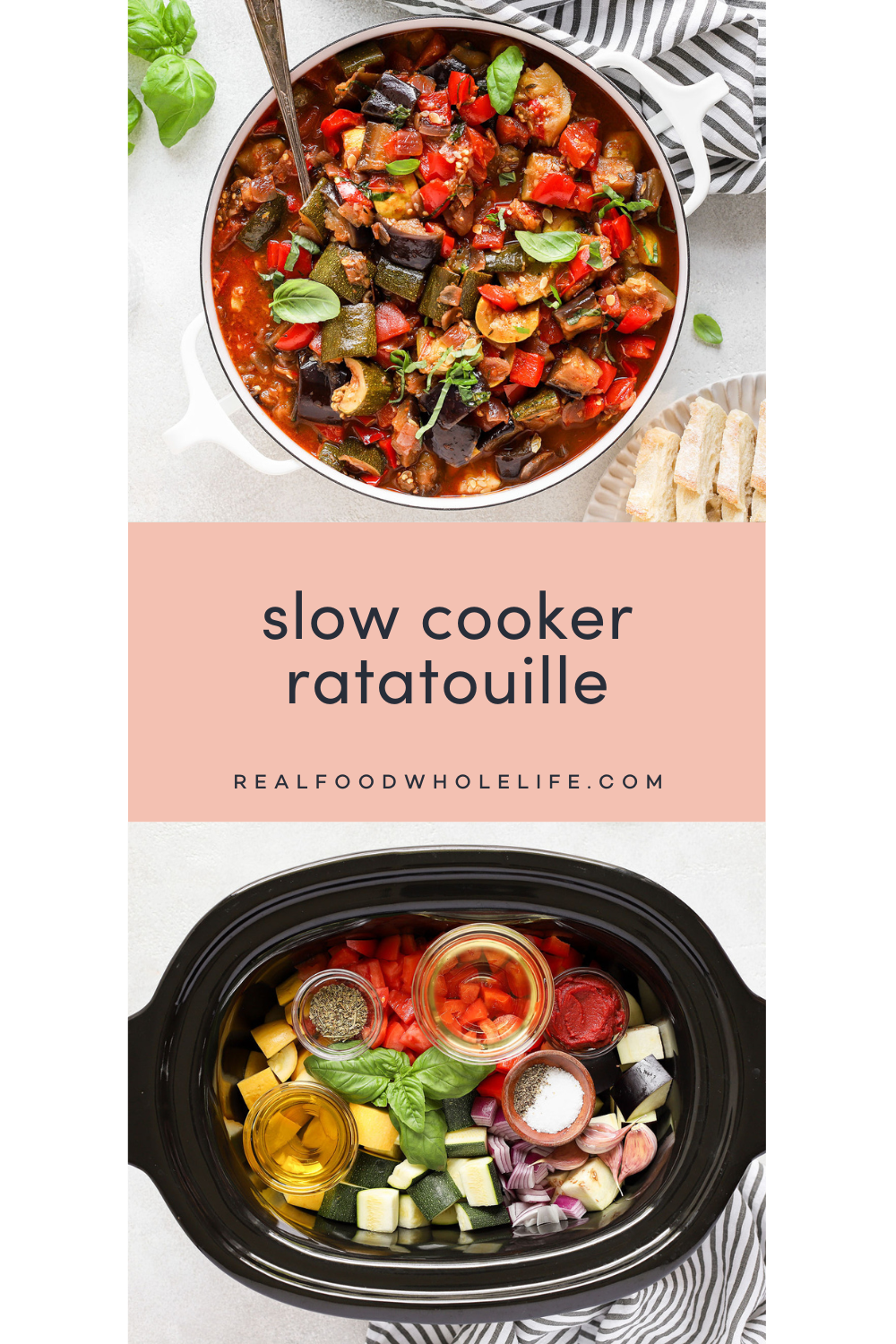
This slow cooker ratatouille is the easiest way to turn a counter full of eggplant, zucchini, bell peppers, and tomatoes into a rich, garlicky French vegetable stew. Hearty enough for a meal on its own, and equally good piled onto crusty toast or spooned over pasta!

My Favorite Slow Cooker Vegetable Stew
Ratatouille has a reputation for being fussy, but in the slow cooker it’s one of the easiest, most forgiving recipes! I started developing this version when my CSA box kept showing up with WAY more eggplant and zucchini than I knew what to do with, and the result is a rich, slow-simmered French vegetable stew that I now make on repeat. It really couldn’t be easier, too. Just chop a counter full of vegetables, saute an onion-tomato paste-garlic mixture on the stovetop with a splash of white wine, and let the slow cooker do the rest!
Okay, as for method, salting the cubed eggplant for 30 minutes before it goes into the slow cooker is non-negotiable. The salt pulls out the bitter liquid that would otherwise leach into the sauce and turn the whole pot watery; skipping this step is the single fastest way to end up with disappointing ratatouille. The other thing that makes a big difference is cook time, which directly controls texture. Three to four hours on high keeps the vegetables distinct and recognizable, while five-plus hours melts everything into a meld-y, sauce-like stew. Both versions are good, so it’s really up to you which version you prefer.
Ratatouille is technically a side dish in France, but in my kitchen it stretches across plenty of dinners during the week. I love spooning it over grilled chicken thighs from my italian chicken marinade for a Mediterranean-leaning meal, or pairing it with chicken made from my greek yogurt chicken marinade when I want something tangy and bright to balance the deep, slow-cooked flavors. It is also incredible piled onto toasted bread with fresh mozzarella and a drizzle of olive oil (HIGHLY recommend), which is how I most often eat the leftovers, or spooned over warmed pasta. The stew keeps in the fridge for up to a week and freezes well for up to 3 months, and the flavors actually deepen after a day or two.

Welcome to My Kitchen, Let’s Make Ratatouille in the Slow Cooker


Testing Tips for Crockpot Ratatouille
- With so many incredible vegetables in this dish, don’t worry if you don’t have one or two. Simply add a little more of a vegetable that’s already on the ingredient list (using zucchini in place of yellow squash, for example). However, I do not recommend subbing in a vegetable not on the ingredient list for this particular recipe.
- If you don’t want to use wine to deglaze the pan, feel free to use chicken stock or vegetable stock (to keep it vegetarian) instead.
- Chop the vegetables roughly the same size, about 1-inch pieces across the board. When I tested with uneven sizes early on, the smaller pieces broke down and disappeared while the larger ones stayed under-cooked, which threw off the whole texture of the finished stew, so consistency at the cutting board pays off in the slow cooker!
- Leftover ratatouille makes an excellent pasta sauce. Blend a cup or two into a slightly chunky puree using an immersion blender, then toss with cooked pasta and a sprinkle of parmesan for an easy lunch. This is one of my favorite ways to stretch a batch across the week without serving the same thing twice in a row!


Slow Cooker Ratatouille (Easy Recipe)

Equipment
Ingredients
- 1 medium eggplant (about 1 pound), cut into 1-inch cubes
- 2 teaspoons kosher salt, divided
- 3 tablespoons olive oil, divided
- 1 medium red onion, cut into ½-inch pieces
- 2 tablespoons tomato paste
- 4 cloves garlic, minced
- ⅓ cup dry white wine
- 2 red or yellow bell peppers, or a combination (about 1 pound), cut into ½-inch pieces
- 2 medium zucchini (about ¾ pound), cut into 1-inch pieces
- 2 medium yellow squash (about ¾ pound), cut into 1-inch pieces
- 3 large Roma or plum tomatoes (about ½ pound), seeded and coarsely chopped
- 1 teaspoon dried no-salt added Italian seasoning, or herbs de Provence
- ¼ teaspoon freshly ground black pepper
To Add at the End
- ¼ cup thinly sliced fresh basil
Instructions
- Add the cubed eggplant to a colander. Place the colander in the sink, sprinkle with ½ teaspoon salt, and toss to combine. Set aside for 30 minutes while you cook the onions and chop the remaining vegetables.
- Heat a large skillet over medium heat. Add 2 tablespoons of olive oil and the red onion. Sprinkle with a pinch of salt, and cook until softened, about 5 minutes, stirring occasionally. Add the tomato paste and garlic, and cook until fragrant, about 1 minute, stirring constantly. Add the wine, stirring to scrape any browned bits from the bottom of the pan.
- Carefully transfer the onion-tomato paste mixture to a 6-quart slow cooker. Give the eggplant a very gentle squeeze to remove any excess liquid, then add it along with the bell pepper, zucchini, yellow squash, tomatoes, Italian seasoning, and pepper.
- Add the remaining 1 tablespoon olive oil and 1 teaspoon salt. Stir until well combined.
- Cover and cook on high for 3-5 hours, or low for 5-7 hours.
- Uncover and add ½ teaspoon salt. Taste and adjust seasoning if desired.
- To serve, remove from the slow cooker and allow to cool to room temperature or refrigerate. Sprinkle with fresh basil and serve as desired.
Notes
- A note on cook time: The texture of this vegetable stew is really personal preference. If you want the vegetables to retain their shape and texture, cook it on the shorter side (e.g., 3-4 hours on high), and if you want the vegetables to meld together, shoot for the longer side (e.g. 5+ hours on high).
- Consistency: Don’t worry if the ratatouille is liquidy at the end of the cooking time. It will thicken considerably as it cools, which is ideal since it is typically served chilled or at room temperature. If not making ahead, consider adding a couple of hours for cooling.
- Don’t want to use wine? Substitute vegetable or chicken stock along with a tablespoon of white wine vinegar instead.
- Yield: Makes about 2 quarts, or about 8 cups.

Very easy to make and tasted delicious!
Amanda, yay, so happy to hear you enjoyed this one, thanks so much for leaving a review!
Looks so good, I’m going to try it. I love eggplant and all the veggies in the recipe. Will let you know how much I love it 😻
Jean, yay, I hope it’s a hit!
Ι was really looking forward to tasting the result of this recipe. I am experimenting with slow cooker and love the fact that for the most part I can prep, put in and forget and then come back to a ready meal. Unfortunately,, this did not go well, despite the fact that I love the individual ingredients. It seriously lacked flavour, it was soggy even though I did not add any extra liquid and the eggplant had a really off putting appearance. I am thinking I should put less tomatoes to reduce the liquid, add more salty flavors and try again. Perhaps add some potatos to make it less soggy? I am not giving up, I like how wholesome it is as a meal and I ll try to find a solution. It can also be that this is a very personal question, as taste often is. Thank you for sharing it though Robyn, as it gives me a base on which to experiment.
Hi Maria, did you see the note about how this recipe will be quite liquid-y at the end of the cook time, but then thickens up considerably once it cools? I’m wondering, did you let it cool? Also, regarding the appearance of the eggplant-did it look different than the photos of the finished dish? When cooked eggplant turns a brown color (regardless of the method) and there’s really nothing that can be done about that. Salt is a personal preference so I agree, adding more to the finished mixture 1/2 teaspoon at a time until you reach the desired salt level is a great idea. Though not “traditional,” you can also add a bit of finely minced raw garlic as well 2-3 teaspoons of red wine vinegar, which will punch up the flavor as well. The flavors also meld well and almost taste better the next day, so refrigerate and taste again in a day and see what you think. Let me know if any of these tips help!
Robyn thank you for taking the time to respond. Today, it really is much less watery. In fact, today the consistency is good. The food does not look appealing, the colours of all the ingredients are no where near as bright as the ones in the pictures. However, I realised one thing and I believe it has negatively impacted the result. I completely forgot to put olive oil! So I am trying it with added olive oil in the plates and feta cheese crumbled to add some saltiness. It actually tastes of something and I am much closer to liking how it tastes. I also think that I added too many carrot tops and it spoiled the taste. I am happy I am doing something with the finished product and I am confident it will taste much better next time!
Maria, yes, the lack of olive oil in the dish will make a big difference in the taste, so definitely make sure not to skip that next time. And you mentioned you added carrot tops? I would definitely NOT recommend adding those. They will change the taste quite a bit in a bad way, and change the color to a muddy brown. In general is you make this recipe again I’d suggest making it as written for best results. I hope that helps!